Showing posts with label art. Show all posts

Friday, September 23, 2016

Somewhat feminist musings at the Musee d'Orsay


The Musee d'Orsay has been one of my favorite museums since I first saw it in 1991, on my first trip to Paris.

What's not to like about a museum that has entire sections/rooms devoted to Van Gogh, Monet, Manet and Degas? Housed in the former Gare d'Orsay train station, a Beaux-Arts structure completed in 1900, the building, with its massive, gold-embellished clocks and elegant arched glass ceiling, calls to mind the setting for The Invention of Hugo Cabret.


Every trip I've taken to Paris since has included a delightful trip to the Musee. But visiting the Musee alongside a teenage girl this summer was a different experience. Sure, she liked its evocation of Hugo, the Impressionist rooms, the Degas sculptures. But after walking through multiple rooms, she asked, "Where are the women artists?"

Each room had been filled with paintings and sculptures of luscious women, prim women, naked women. But we had seen one lonely artwork by a woman--Mary Cassett, among the Impressionists.

After that, the rest of our afternoon tour became a bitter hunt for female artists. We rushed from artwork to artwork, examining the placards for any hint of a female name, but we never found another woman's art there.*

If you google "female artists at the Musee d'Orsay," the hits on the first page include the museum's own pages for The Modern Woman. Drawings by Degas, Renoir, Toulouse-Lautrec and Other Masterpieces from the Musée d'Orsay and Splendour and Misery. Pictures of Prostitution, 1850-1910. In other words, women interpreted by men.

What were women doing while all these men had been sculpting, painting, creating? Tending to children? Devoting themselves to maintaining their own beauty? Posing for male artists? Or, perhaps, making art that would never be housed in the Musee d'Orsay.


------------------------------------------------------------------------------------
* I discovered after I returned home that the museum does house a few other female artists, including Berthe Morisot and Cecilia Beaux--but the number of artworks by women is pretty paltry compared to the hundreds by men. (I am counting 12 total among these three women). And to find them, I had to use Wikipedia and go through a list of major artists at the Musee. Otherwise, the Musee's website led me to paintings and art about women rather than by women.


All photographs by Beth Blevins. Copyright 2016.

The Seine seen from one of the clocks at the Musee d'Orsay.

Tuesday, September 20, 2016

While reading Cheryl Strayed's Wild...


1.
I am listening to Wild on audiobook in my car. Like the people in those Audible ads, I am immersed in the book. I may appear to be driving, but I'm hiking hot stretches of the Pacific Coast Trail or rounding an icy bend balancing the weight of my pack. I push on to the next goal post by pushing my foot on the accelerator, driving further in an hour than what Cheryl Strayed walked in a day. I'm only running errands, yet I emerge from my car feeling I've accomplished something akin to a hero's journey.

2.
As I drive and listen, I contemplate the question: why did Strayed keep hiking after her toenails fell off? After her pack bruised and skinned her? After she nearly died of heat exhaustion and thirst? Most people would have quit when the first toenail turned black or after the first encounter with a rattlesnake.

But the answer is in every line of the book. She didn't quit because she had nothing else. No home, no other destination, no one needing her to be somewhere particular. Just desperate determination, and the trail ahead.

Maybe it's desperate determination that separates good artists/singers/actors who acquiesce to careers that pay the bills and push their art to the side, and those who  continue to create because they must. Without desperation, a lot of art wouldn't be made or made visible.

3.
Her hike isn't entirely a fantasy for me because I, too, have hiked in California mountain and desert. I, too, have stuck out my thumb and gotten rides along quiet roads and busy highways there. At one time in my life, almost all of my possessions could fit into an external-frame Kelty backpack. I had no ambition but to see new things and talk to people in different towns. I wanted the world to be my education.

4.
It's funny typing this, on a Mac computer, in my house in Maryland. Now all my possessions would fill a large moving truck or two. The Kelty backpack is long gone, traded for money or gas to someone in a town left behind. Just as Cheryl Strayed eventually got off the trail, I, too, moved on to my life. After an off-and-on relationship with college, I finished my degree at about the time I quit hitchhiking and long-distance hiking. Now I rarely see the wilderness and hike only on well-worn trails.

It is without much nostalgia that I think back to being young and hiking in the heat of the Mojave Desert, or camping on high, snowy ridges in Southern California. I don't want to be that unrooted young woman again, yet I'm enjoying being reminded of her/me as I listen to Wild.

5.
Perhaps every life is a hero's journey, getting from there to here, and we don't recognize it as such. Even ambling we can reach our destination or create it as we go along.


Tuesday, May 21, 2013

Can beauty co-exist with guilt?

I've been gardening as many hours as I can each day, as I am wont to do in the spring, so I won't be blogging much here as long as the mornings and late afternoons remain relatively cool. Being outside digging in the dirt reminds me of when I was a child, wandering the woods by myself—there is a peaceful solitude to it, though it's tinged sometimes with loneliness. Yet the loneliness is a small price for the  delicious feeling of exhaustion I have at the end of the day—this is what work is supposed to feel like.

(I am writing this post because it was too hot to work this afternoon.) I look forward to writing more consistently when the heat, humidity—and mosquitoes!—return to the Washington Metro area, probably by the end of the month. Until then, I hope to get the oak stump mulch spread on my slopes, repot the basil seedlings, feed the azaleas and plant spring onions.


One of the first things I do each spring is plant the pots on my deck with colorful flowers, which I look out on as I wash the dishes each day. The colors cheer me up in the midst of my dull tasks.

Underneath them I keep a variety of sempervivums in shorter pots to provide additional color. (Sempervivums thrive even with neglect and little watering, making them the ultra-dependable plant). This weekend I repotted my sempervivums from their faded terra cotta pots into some colorful and inexpensive pots I found at Home Goods. I specifically wanted at least one blue pot since it is my current favorite color. The pot I found (seen above) makes a gorgeous contrast to all the other beige and brown pots there.

But as I peeled the "Made in China" tag off the side, I began to wonder about the people who made this pot for me. Did the factory they worked in have natural light and clean air? Were the conditions safe? Were they paid enough to live a decent life?

It is the same, nearly always, in any store I go into. I always wonder about the people who made the clothes and goods I have come to purchase—but the recent Bangladesh factory fire has made me even more aware of this. It is a guilt or awareness I can't turn off, at least while I am in a store—making it difficult sometimes just to buy anything there.

Is something really beautiful if is was forged with a degree of exploitation and danger? I eat food that has been picked by underpaid farmworkers because I need to eat. But do I really need that new sweater or this new pot if getting it here as cheaply as possible meant that safety measures were ignored, that people weren't paid enough for their time and work, that pollution resulted?

I ponder this as I look out at my new pot. I would like to see just its beauty, its blueness—I know my guilt does no one any good anyway. Yet this is part of its essence which I can't seem not to see.

Tuesday, December 18, 2012

Creativity not violence


I spent much of the weekend grieving about the Sandy Hook ES shootings. Then a skit on Saturday Night Live, an adult parody of "You're a Good Man, Charlie Brown," pushed a little of my sadness into a meditation on why some angry and/or crazy males turn to guns, while others turn to art.

Biographies of Charles Schultz paint him as a man who "specialised in making art out of angst," who "grudgingly held on to every indignity and insult he ever received and used them later on to fuel his strip"—including experiences beyond his awkward childhood. This transformation of bitterness into the long-running "Peanuts" comic strip (and all related TV shows and licensed products) made Schultz a rich and famous man, exacting the best possible revenge on the childhood peers who ignored him.

Such angst has played out again and again in other lives and bedrooms. It has fueled heavy metal and moody goth songs, crude cartoons and abstract paintings. The lucky boys find guitars or paints or pens or cameras or street dancing. They may not be good enough to make a living at it, but it gives them an outlet, it lets them use their anger (and their vibrancy) for something that, if not beautiful or the highest art, at least causes no damage to anyone else.

What I see a lot of now, though, are groups of teenagers (or, worse, single teenagers) playing video games where they spend hours shooting aliens and "enemies." Hours and hours not out in the sunlight, not laughing or being goofy, not making something with their hands—with only a single purpose to garner as many "kills" as possible.

I am not calling for a ban on video games (what's the use of that?). But I would like to see some kind of cultural shift where young men are encouraged to be creative and expressive, especially in groups. Right now, teenage boys who are not gifted at sports have almost no other group activity they can engage in outside of school other than video games. Organizations like Guitars Not Guns aim to "encourage children and teens to use their creativity to foster personal development and to help divert them from self-destructive influences." But their intention is on at-risk youth, not alienated white suburban teenagers.

I propose this as something that can be discussed outside of the current debate about gun control. I am not sure any of this would have prevented the Sandy Hook shooter (I won't use his name) from doing what he did. How much more heroic and life-affirming had he instead just scrawled bad poetry in composition books or strummed amateurish rock songs. I wish somehow I could praise him, and others like him, for doing that instead. And, yes, I understand that he was mentally ill. But mental illness has not kept some artists from creating beautiful things. The autistic knitter created interesting and gorgeous yarn creations. Her handiwork is housed in a museum, not a morgue.

Friday, July 6, 2012

The happiness of perpetual creativity

The endomosaic window that Norman created for the SF Masonic Memorial Temple

I saw a great documentary about Emile Norman (whom I'd never heard of before) a couple of weeks ago on PBS. It was inspiring to see him still making art at age 91; his creativity permeated everything he did. The film showed him in the wee hours of the morning happily jigsawing small pieces of wood for sculptures and mosaics in his gorgeous home in Big Sur that he had built with his partner, Brooks Clement.

Norman had a lot of things in his life that could have made him angry—his family rejected his artistry and his homosexuality, and he lived in a time in which he could have been persecuted just for being gay. Yet he found a way to be productive and prosperous, in his own version of paradise.

What I found most inspiring was his joyfulness, the ongoing, obvious pleasure his creativity gave him. As he said in the movie, "I love to experiment, see if this works, that works... It's fun!" Later he added, "I'm here, I have a gift, and it's my duty to use it. I'm so happy when I'm working. The most important thing in my life is when I'm sculpting and doing artwork. That's my reason for being here." And, as he predicted, "If I stop doing work, call 9-1-1 and tell them to come and get me."

There are so few people I know in real life (or who are depicted on TV) who are joyfully creative—except maybe young children. I don't know how we lose that playfulness or where those creative impulses go—shopping and acquiring, worry, doubt? People like Emile Norman help pull us out of the stale, static rooms of our lives.

Sunday, April 8, 2012

Precision and perseverance, remembered in fiber


I'd never thought much about coverlets until I happened upon the National Museum of the American Coverlet in Bedford, Penn., last week. The museum aims to give "coverlets the recognition and respect they deserve, while bringing their history to life."

Unlike quilts, coverlets are made on looms and in the past, given the smaller size of home looms, were usually made in at least two parts to make them wide enough to fit across the bed. This required a preciseness in weaving so that both parts matched as perfectly as possible. Coverlets made for home use by women usually had simple geometric patterns, so stitching them together was not that challenging. But some weavers turned coverlets into an art form, creating intricate designs, perfectly matched. These makers wove their names into them, often in all four corners of the finished product, backwards and forwards.

Coverlet weavers who did this for money worked up to 18 hours a day, often in unheated sheds, according to Melinda Zongor, the museum director who gave us our tour. It took strength and perseverance to make a coverlet, in addition to nimble fingers and a craft sensibility. But the women who wove coverlets (and other linens for their families' use) often did so in between tending babies and doing all the work required of them to keep the household going. Each day was a series of nonstop chores, none of them much remembered. And yet, here some of their  coverlets had survived and traveled through the centuries, from their small looms to this wide space.

Though the main purpose of the coverlets was to keep people warm at night, I realized they also served a more intransient purpose—to give evidence of these weavers' lives beyond names on gravestones or recorded in family histories. Each coverlet was motion captured, an idea completed, a life remembered in woven fiber.

Monday, December 19, 2011

Another woman's work rescued from the trash


The December issue of Smithsonian Magazine includes a short article on Vivian Maier, whom it calls a "photographer of consequence." Never heard of her? That's because Maier, who worked as a nanny, didn't sell a print in her lifetime and rarely shared her photos with friends and neighbors. Her photos came out in the open only because she could no longer pay rent on the storage unit where they had been kept. A stranger, John Maloof, bought a box of 30,000 negatives for $400 in 2007.

By the time Maloof began sifting through the negatives, Maier was dead. Fortunately, Maloof liked what he saw and started posting her photos on a blog. He also has issued a book of her work (which, probably due to the magazine piece, is out of stock at Amazon right now).

You have to wonder how many other female artists haven't been so lucky—lacking any kind of postmortem discovery or champion.

How much work by women has simply been thrown away? Perhaps this is true also for good and even excellent work by male artists and writers who have had the misfortune to remain unknown. But from all of antiquity we have one complete poem from Sappho (and a few other line fragments), and a handful of lines from other female writers—compared to the multiple volumes by men that are arranged in the Loeb Classical Library.  There is little or no female perspective remaining from those centuries—the voice of all those women is eerily silent.

The above photo is from a direct link to a page on Maloof's blog.

Friday, September 17, 2010

More on Deborah Berger, the autistic knitter


After I uploaded my post on Deborah Berger, whose knitted pieces are on exhibit at the American Visionary Art Museum, I regretted that I hadn't contacted the museum to see if they could have provided more information about her. I'm glad to say that AVAM answered my subsequent email and sent me three photos of her pieces, as well as a short biography, which I'll include below. (As far as I know, this will post will contain the only information about Berger—other than my first blog post—and the only pictures of her work, available right now on the Internet).


Biography:

Deborah Berger was born with autism in New Jersey in 1956. She attended residential schools for special-needs children in Pennsylvania and Texas, and graduated from Middlesex County Community College in New Jersey. Berger learned to knit while still a young child, and was soon a knitting prodigy. Before she was ten, she was able to create not only all her own clothing, but toys, games, and complex sculptural forms from yarn. As an adult, Berger was high-functioning enough to live on her own and keep an apartment in New Orleans, but she never held a regular job. She was often in trouble with the police for disruptive or inappropriate behavior in public. Most of her income came from her relatives, supplemented by work as a nude model for artists. A loner, she continued to knit throughout her life, developing an extensive wardrobe of colorful, idiosyncratic pieces in a style all her own, as well as a large collection of masks and mask designs drawn on paper. After Berger died in 2005, her family discovered that her living space was overflowing with her knitted work and began the process of disposing of it. A member of the Arts Council of New Orleans discovered much of it in a pile of trash and rescued it, saving it until a voudou historian helped her transfer it to the permanent collection of the American Visionary Art Museum. This is the first time Deborah Berger’s work has been presented in any museum.


Photos courtesy and Copyright, American Visionary Art Museum.

Saturday, August 21, 2010

The nearly lost art of the autistic knitter

A couple of weeks ago, we went to the American Visionary Art Museum in Baltimore for the first time. The museum features "outsider" art—art made, primarily, by people without formal training but with an intense need to create something unique or beautiful or visionary.

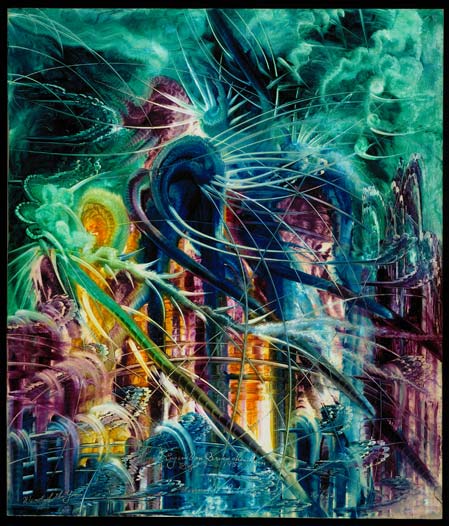
There were many things I loved at the museum, especially: the mesmerizing, kaleidoscopic paintings of Eugene Von Bruenchenhein, a baker who made paintings on his kitchen table after-hours (one of his paintings is shown above); the memoir paintings of Russian prince Andrew Romanoff, made entirely on shrinky dinks; and tiny paintings and sculptures selected from Richard McMahon's ongoing mini museum project.

But the exhibit that gave me the most pause was a block of bizarre crocheted pieces in the middle of the floor—a headpiece that looked like it was made for an alien, a striped, rainbow-colored coat, and more neutral-colored hats, all done with incredibly precise needlework. The plaque next to them said they were done by Deborah Berger, an autistic woman who was a knitting prodigy. Berger lived in New Orleans and worked as an artist's model by day, then came home and knitted nonstop for hours. After Berger died, her family threw out all her pieces, but someone from a New Orleans arts council rescued some of them.

Unlike the other artists I've described in this post, I cannot find a picture or even a description of Berger on the Internet. As far as I know, the most visible trace of her existence is on that block of wood in a museum in Baltimore. AVAM doesn't allow photos indoors, so I cannot show you what they look like (which is why Von Bruenchenhein's painting is shown above).

When she sat alone in her apartment, knitting furiously, was this her intention? Is a museum the ultimate destination, the best possible place for her work? Yes, probably, but still there's something a little lonely about it. One wishes that one of her subdued hats would grace the head of a distant cousin or great niece, that her family had wished to keep some part of Aunt Deborah's weird and wonderful art for themselves.

After I wrote this post, AVAM sent a short biography of Berger and photos of her work. See addendum post for September 17, 2010

Monday, June 28, 2010

Dance, the ephemeral art

Athough I normally avoid reality shows (because I'm not interested in dieters, dysfunctional families, or desperate "celebrities"), E-girl and I have been making our way through taped episodes of the current season of "So You Think You Can Dance" (SYTYCD).

Why? Because E-girl loves to dance. Even in utero, I realize now, she was trying to tap. She says she wants to be a professional dancer when she's older, for a few years, before she becomes a botanist and mom. She realizes there's an end to it already.

Is there any art more ephemeral than dance? Not just the performance, over in a few minutes. But the dancer's body itself—fleetingly supple and strong, particularly for ballet (and, probably, for break-dancing and hip-hop). Picasso was still producing art into his nineties, John Updike was writing and lecturing in his seventies. Old dancers can be teachers or choreographers, but if they still dance it's probably in solitude, without the audience they once hungered for.

Ironically, dance—the art form of motion—is the most static of art forms. It stays in place and can't be easily transported or transformed into another, more mobile medium. A painting can decorate a t-shirt or become a poster; a song can be heard while jogging or driving; words can become text which can become books or magazines or newspapers. Dance doesn't become anything else—it just is.

So the young people on SYTYCD may already be at their peak as dancers, or nearing it, which makes the dancing more precious and beautiful. You wish they didn't have to be judged and voted upon and eliminated, but could just be celebrated for their skill and enthusiasm.

I don't like the results show, the evening after the individual performances, where the dancers are lined up and told which ones got the lowest number of phone-in votes from the public. The bottom three are each given a minute to dance for their survival. I watch this part of the show with a finger on fast forward because it's too painful to watch, yet I still can't not watch it either. It's like a little death each week. And then the next week, the competition begins again and the cut performer is forgotten. The dance goes on.

(The illustration is a sepia-tinted snapshot of the "Hallelujah" dance from the first competition evening of this season's SYTYSD.)

Wednesday, June 23, 2010

Why it sucks to be a (visual) artist

"The Wilkersons’ costliest board was the 1972 painting Water Dreaming at Kalipinypa, a dazzling patchwork of stippled, dotted and crosshatched shapes, bought in 2000 for some $220,000—more than twice the price it had been auctioned for only three years earlier. The painting was done by Johnny Warangkula Tjupurrula, an original member of the Papunya cooperative and one of its most celebrated. Sadly, the artist himself had long been overlooked; in 1997, an Australian journalist found Warangkula, by then old and homeless, sleeping along with other Aboriginal people in a dry riverbed near Alice Springs. Though he reportedly received less than $150 for his best-known painting, the publicity surrounding the 1997 sale revived his career somewhat..."

From: Contemporary Aboriginal Art, Smithsonian Magazine, January 2010.

Monday, November 2, 2009

The illustrated journal as art/the blog post as illustrated journal


A short article in this month's Smithsonian magazine has inspired me to look at blogging (and also, perhaps, journal keeping) in a new way.

The article, Drawn From Life, describes how the museum's Archives of American Art has acquired artist Janice Lowery's lifetime collection of illustrated journals (a page from one of them has been inserted above; click on the photo to see it whole).

I read the article shortly after a friend of mine commented that "I always seem to read your blog when you're talking about writing." I didn't know how to respond to her comment—I've tried to restrain the discussion here to creativity/writing ever since a workshop speaker told me I was doing this all wrong because my previous blog couldn't be described in five words or less. (Writing and creativity is still a wide net, though, compared to such blogs as The Brian Williams Tie Report or The Truth About Cars, et al.).

But seeing pages from Lowry's journals has inspired me to incorporate more visual aspects to this blog and to my irregularly updated, offline journal. I've taken photographs that will never go in a gallery, so why not post them here? I'm not saying the blog will be entirely visual, or necessarily go beyond the usual small illustration at the top of each post. But I now have the inspiration to do with the page and the blog post box what I will.

(For more pages from Lowry's journals, see the Smithsonian page, Journal 101.)

Friday, March 13, 2009

Artist Profile: Chandra Garsson


I knew of only two other people in college who were as low on funds as I was. One was Therese, a dancer/choreographer who was so broke she auditioned for and became the Chicken at the Santa Cruz Boardwalk. The other was Chandra Garsson, who wanted to spend her time making art and was always scratching up money to pay the rent. Once she and I were so broke we had six dollars between us and we decided to blow it all on going to the movies—three movies in one evening, skipping from theatre to theatre in a small multiplex, a desperate, extravagant gesture (and the reason why “Gregory’s Girl” somehow loops into “Blade Runner” in my memory).

Chandra and I once spent several evenings designing postcard collages for money, which neither of us knew where to sell once we were done. Not knowing where to sell something I’ve produced has been a theme in my life since that time. Chandra has managed to do better in this regard—she has had exhibits and gallery openings, including Insomnia (Awakening), an exhibit sponsored by Pro Arts Gallery, and the city of Oakland. But her art has not been a constant or stupendous source of income for her.

Chandra is the only artistic person I’ve known since college who can still claim being an artist as her main identity. The rest of us have gone on to work as professors, teachers, editors, librarians, etc. Although she also dedicated much of her life to teaching art, she has consistently continued to produce visual art, and has held an exhibit almost every year since then.

The last time I saw her she was living in a section of an artists’ warehouse, the Dutch boy, in Oakland. Her junkyard chairs had been painted royal blue, with a golden skeleton sitting in each. Her couch was covered in canvas that had been painted beautiful, wild splatters of primary, secondary, and tertiary colors. The walls of her studio were covered with paintings, prints and collages, and corners held mannequins that were painted in keyed-up metallic colors and transformed into assemblaged surreal, other-worldly archetypes. She now lives in a smaller apartment by a lake in Oakland, having lost her battle with her former landlord, who wanted to turn the art studios into luxury apartments and office space. These days, she concentrates on smaller projects, including making jewelry, due to her smaller living space and her art studio being separate from where she lives.

For more on Chandra, see
http://www.darksecretlove.com/chandra, a web page devoted to her art or her Facebook Fan page (which I started).

WH: What is the biggest difficulty for an artist starting out, as you did, after college? Did you have any connections with galleries or people who ran galleries? Did art professors you had help in any way?

Chandra Garsson: Poverty has always been my greatest challenge, along with exploitation by an almost wholly unregulated rental industry, both residential and commercial, legal and illegal. (I am fortunate in my landlord at my present art studio. It is an equitable, friendly relationship, with a very kind family.) I formed initial connections to galleries and museums. I did gain some renown, so I was at intervals contacted and recommended for exhibitions. While after graduation from BFA and MFA programs professors helped with letters of glowing recommendation, it was not always apparent from the many rejection letters I received over the years that images were viewed or the letters were read, perhaps because nothing was immediately translating for the recipients into dollar signs.


How did you forge ahead with an art career? Did getting a Master of Fine Arts degree help?

C.G: I’m not sure I did much “forging ahead,” except in the work itself, as must be distinguished from the career. Of course the MFA is helpful to most artists in their creative work, certainly it was to me. Knowledge is the only real power, and the discipline and exposure to voluminous visual and written materials, other artists, a constant tour of galleries, museums, artist’s studios, is beyond measurement.


Have you tried to do other things, or has art always been your main focus? (Did you ever consider being an art teacher? Is it difficult to get that gig?)

C.G: I have been as one-pointed as any, and most artists are. I have devoted much of my life as an artist to teaching, a secondary yet fully compatible calling. The symbiotic relationship for the artist between creating and teaching worked especially well for me. I am a communicator, visually and verbally. Colleges have increasingly cut back what is offered to teachers since I have been in the job market.

What types of jobs/work have you done to supplement your income as an artist?

C.G: Aside from teaching, I have been a telemarketer and fundraiser, a waitress, switchboard operator, home health care-taker, baby-sitter, elder-sitter, day-care teacher, housecleaner, youth hostel cleaner, hospital cleaner, chai walla (in an office building in Amsterdam), dishwasher, kitchen worker at a Yoga Center, seamstress, department store cashier, and more…plus my favorite job, sitting in a campus Art Gallery, a very easy job I did for several years. In those days all that was required of me in this work was to watch and make sure nothing was stolen, greet people in a friendly manner, have conversations when desired by a visitor to the gallery. I conversed with friends, studied, dreamed up art projects, and sneaked the occasional catnap. I think this is the job that spoiled me for all other jobs. Sigh.

Has the economic downturn had any effect on the sales of your art, or is it always about the same?

C.G: Sales of my art have always been very up and down, most often down. The jewelry was doing better until the economic downturn, then sales fell off sharply. It seems to me the downturn has been coming on for longer than a decade, but that could just be me.


How would you describe and summarize your artwork in a few sentences?

C.G: My artwork is largely autobiographical, hugely environmental, and wonderfully humorous in its willingness to address the darker, scarier aspects of the world around me.

How is it environmental?

CG: Largely, most of the components that go into my work would have ended up in a landfill. I estimate that I have saved at least 50 tons of trash, including industrial trash I found around my old studio at the warehouse in East Oakland. I’ve also used items from junk stores and flea markets, and things that people have found and have given to me, including dolls, mannequins, antique glass slides and animal bones. I have been poor in money and rich in materials!

When did you start using mannequins and dolls in your work?

C.G: I have always had an affinity with dolls, and mannequins to me, are large dolls. Dolls are, after all, sculptural representations at various stages of the human being, usually girls and women, which I was and am, respectively. They echo back to a helpless, vulnerable time in my life, when as a child, art and dolls were intricately intertwined as expression of an inner world that only I controlled. I suppose it could be said that this has never changed.

Are you doing more assemblage/collage than anything else, or do you do split your efforts between printmaking, painting and assemblage?

C.G: I’ve been doing all of the above except for printmaking, an art I have not practiced for many years. Lately I have been working with raw minerals and crystals such as Carnelian, Turquoise, Amber, Ruby, Prehnite, Moonstone, Garnet, Amethyst, Emerald and Flourite.

If I could wave a magic wand and affect your career, what would you most want to happen? Sales? Exhibits? Recognition? Something else?

C.G: 1. Recognition. 2. Something else (a greater sense of community between artists, myself included, and various systems of support for the artist). 3. Sales. 4.Exhibits.


What would you like to happen in your life and your art in the next ten years?

CG: I would like to find good homes for all my artwork in the next ten years. They all need to be adopted into good families or to individuals that would take good care of them. A museum or several museums could house them all.

You told me once that you had transformed a public bathroom into a painting studio because it had good light. Are you still there, or how long were you there? Were you ever caught?

C.G: That was at Kala Institute, in Berkeley, where I made etchings and monotypes. It was a bathroom, large and light, custodially cared for. I kept my taboret and supplies in one of the stalls, and crawled under a door to unlock them, brought them into the center of bathroom to paint by the open window facing northwest. The sun filtered in afternoons, it was an idyllic place to paint. Almost no one used it, but one day someone came in, and told the director of Kala, Archana Horsting, about it. She confronted me, I explained, she listened, and reminded me to keep the supplies locked in the stall, out of the way. She reminded me to clean up all the paint each time. She sent me on my merry way. Archana is a fine person. Kala is a wonderful printmaking facility.

Do you feel that the artist is justified in doing anything; taking anything she needs, as long as she produces good art? (Does the artistic end always justify the means?)

C.G: Generally, there is a great deal to the notion of artistic license, as long as no one, including the artist, is hurt. Your use of the word “anything” is more than a bit open-ended. Come to think of it, the word “take” is more than a bit suspect. I have always striven for the quality of harmlessness. I am quite a moral person, one could say didactic, in the messages of my work and life.

Have you known artists who have achieved fame, undeservedly, because of who they knew or who they slept with?

C.G: Goodness gracious, girl! Um, let’s just say that as an artist who has not made it to the top, I do not personally know artists at the top, so I do not know, and let’s leave it at that. If it were to happen, I would view it as unfair exploitation of the artist, by one with far greater power than the artist in our world ever has, unless a jolly good time was had by both parties.

Has doing yoga had any effect on your art?

C.G: Yoga has had a profound effect on my art, and my art has had a profound effect on my yoga practice. They are compatible practices—one informs the other, both are enhanced by the dual focus.

How about being Jewish?

CG: Being culturally, racially and spiritually Jewish is also compatible with yoga and art.

And being feminist?

CG: One of my professors, Sam Richardson, told me several times in grad school that my work is strongly feminine. I have realized since, over the years, that my work is emphatically feminist—which is completely compatible with being Jewish, environmental and doing yoga.

What keeps you going as an artist?

I have important things to say and art is the best way for me to communicate those things to the world.

Thursday, March 12, 2009

Postcards from Santa Cruz

Color comes to my blog for a day...

Here are some of the postcards I made alongside Chandra Garsson in Santa Cruz throughout the summer of 1982. (This will be mentioned in my interview with her tomorrow). We had hoped to have them reproduced, to sell as artsy postcards, but back then color xerox was $1/page and we couldn't figure out how to make a profit on the endeavor. 

I spent most of 1982 writing, taking photographs and doing collages, nearly unemployed and broke, supposedly writing my undergraduate thesis on The Aeneid (which I ended up writing and typing up one week in June 1983, just before it was due). It was a hard year. I was sick a lot, partner-less and didn't know what I was going to do once I had my B.A., which was one reason I kept putting off writing my thesis—as long as the thesis wasn't finished, I was still a "student," not just another Santa Cruz hanger-on.

And yet, seeing these postcards again, and remembering the many nights that Chandra and I stayed up together, working to make art for money but ending up with odd and sometimes beautiful collages as well as a lifelong friendship, I don't see that summer or even that year as a waste. 

(This postcard is a pic I took of Chandra that summer, painted and mounted on pasteled paper)

That summer of frenzied art also helped me realize I don't have enough guts or talent to be a visual artist. That's why I admire Chandra so much. She kept at it while I retreated to the quieter craft of words.