Showing posts with label permanence. Show all posts

Monday, December 19, 2011

Another woman's work rescued from the trash


The December issue of Smithsonian Magazine includes a short article on Vivian Maier, whom it calls a "photographer of consequence." Never heard of her? That's because Maier, who worked as a nanny, didn't sell a print in her lifetime and rarely shared her photos with friends and neighbors. Her photos came out in the open only because she could no longer pay rent on the storage unit where they had been kept. A stranger, John Maloof, bought a box of 30,000 negatives for $400 in 2007.

By the time Maloof began sifting through the negatives, Maier was dead. Fortunately, Maloof liked what he saw and started posting her photos on a blog. He also has issued a book of her work (which, probably due to the magazine piece, is out of stock at Amazon right now).

You have to wonder how many other female artists haven't been so lucky—lacking any kind of postmortem discovery or champion.

How much work by women has simply been thrown away? Perhaps this is true also for good and even excellent work by male artists and writers who have had the misfortune to remain unknown. But from all of antiquity we have one complete poem from Sappho (and a few other line fragments), and a handful of lines from other female writers—compared to the multiple volumes by men that are arranged in the Loeb Classical Library.  There is little or no female perspective remaining from those centuries—the voice of all those women is eerily silent.

The above photo is from a direct link to a page on Maloof's blog.

Wednesday, December 7, 2011

A mission of salvation in a dark basement room

Yesterday I scavenged through a dead woman's bookshelves. Although I don't know her name, or anything about her except that she was a former school teacher and a survivor of the Holocaust, I came to admire and like her in the couple of hours that I was there in her dark, empty house.

The books we found there gave evidence of an intelligent person with eclectic tastes: hardcover, first-edition novels (from Lolita to Star Trek), a collection of Samuel Beckett's work (in English and French), travel books, cookbooks and issues of Bon Appetit, humor, biography, and trendy psychology—written in English, French, German, Spanish and even Russian. She had been a voracious reader—there were stacks of books in other rooms of the house,  and they obviously had been read because almost every one contained scribbled comments on the inside front page that summed up her reactions, e.g., "...highly amusing" and "...a suspenseful read."

My companion and I were there to take out what we could for the local high school's annual book sale because no one else wanted her books. She had been single, childless and elderly, and after she died in that house, no one came to claim her books. In fact, the realtor who bought it was just going to throw them away. We were there on a mission of salvation.

Looking through her collection, I was reminded of the autistic knitter. This woman's book collection also represented a kind of art form or life's work. And all of it, including her tiny commentaries, had been destined for a garbage can. Perhaps there was other evidence remaining of her life beyond that quiet house—art works or crafts or letters she had written, still preserved by companions or the sons and daughters of her companions—but I doubted it. With a sinking feeling, I felt like I was deciding what part of her would go on, even if only to strangers that won't know her name.

But what struck me more was the sudden realization that if everything she had read had been on an e-reader, my friend and I wouldn't have been there in her house in the first place, and I never would have spent those few moments in her lingering presence. All those titles, the odd juxtapositions of Art Buchwald and Ferlingetti and science fiction paperbacks, gone in a blip.

Saturday, August 21, 2010

The nearly lost art of the autistic knitter

A couple of weeks ago, we went to the American Visionary Art Museum in Baltimore for the first time. The museum features "outsider" art—art made, primarily, by people without formal training but with an intense need to create something unique or beautiful or visionary.

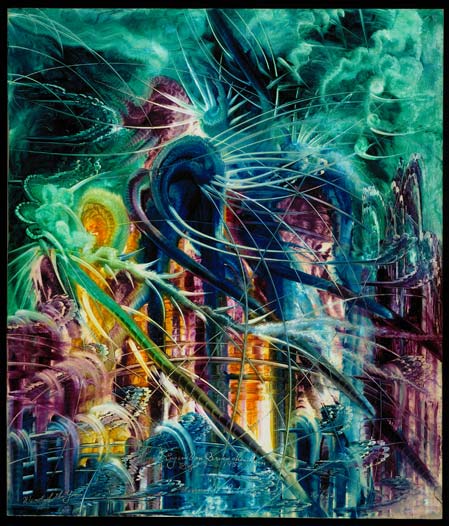
There were many things I loved at the museum, especially: the mesmerizing, kaleidoscopic paintings of Eugene Von Bruenchenhein, a baker who made paintings on his kitchen table after-hours (one of his paintings is shown above); the memoir paintings of Russian prince Andrew Romanoff, made entirely on shrinky dinks; and tiny paintings and sculptures selected from Richard McMahon's ongoing mini museum project.

But the exhibit that gave me the most pause was a block of bizarre crocheted pieces in the middle of the floor—a headpiece that looked like it was made for an alien, a striped, rainbow-colored coat, and more neutral-colored hats, all done with incredibly precise needlework. The plaque next to them said they were done by Deborah Berger, an autistic woman who was a knitting prodigy. Berger lived in New Orleans and worked as an artist's model by day, then came home and knitted nonstop for hours. After Berger died, her family threw out all her pieces, but someone from a New Orleans arts council rescued some of them.

Unlike the other artists I've described in this post, I cannot find a picture or even a description of Berger on the Internet. As far as I know, the most visible trace of her existence is on that block of wood in a museum in Baltimore. AVAM doesn't allow photos indoors, so I cannot show you what they look like (which is why Von Bruenchenhein's painting is shown above).

When she sat alone in her apartment, knitting furiously, was this her intention? Is a museum the ultimate destination, the best possible place for her work? Yes, probably, but still there's something a little lonely about it. One wishes that one of her subdued hats would grace the head of a distant cousin or great niece, that her family had wished to keep some part of Aunt Deborah's weird and wonderful art for themselves.

After I wrote this post, AVAM sent a short biography of Berger and photos of her work. See addendum post for September 17, 2010