Showing posts with label children's books. Show all posts

Thursday, June 5, 2014

Growing up, page by page


And so we ride along the streets, immersed in stories. Who knows what the other people sitting at the traffic light are listening to—talk radio? shock jocks? light rock? We are rehearsing for a holiday concert, struggling to survive in a prairie cabin, or walking to school in our new rain boots. And, sometimes, when we delve into fantastic tales like the Spiderwick Chronicles, we can almost see the fairies flying by.
from: The writer, reading (listening) (posted Nov. 15, 2009)

I wrote that blog post four and a half years ago. I knew that we couldn't stay in the land of Pooh or The Little House forever, yet even as they slipped further and further into memory, I thought we still might revisit them occasionally with books on CD in the car.

But the last kid's book we listened to together was Syren (book five of the Septimus Heap series) more than a year ago. A couple of chapters in, E-girl complained that it was nearly the same plot as the last and that Septimus's sister, Jenna, always served the same annoying, inquisitive role. And it was getting bor-ring.

We tried to listen to young adult books together, but there's something discomfiting about listening to a book with your mom (The Future of Us) in which teenagers discuss being "felt up" and having erections. So it's back to the radio for now.

Listening to the radio is a different kind of education for E-girl—and for me. For example, I  know that "Demons" and "Radioactive" are both from Imagine Dragons. I am glad to hear her expressing strong feelings for Nirvana, and for trying to like good heavy metal bands like Metallica—and for turning the channel when Justin Bieber comes on...


Friday, October 18, 2013

How to find the "best" children's books

During a lull at the library yesterday, I began to browse around for "best of" book lists for children, middle-schoolers and teens. I know that such lists neglect many great books, and if you stringently sticks to a list, you might not find the best book for a particular child at a particular time.  However, for me, this is a good starting point/reference tool! 

Preschool and kindergarten
• Caldecott Medal and Honor Books, 1938 - Present
Full list (includes Honor books, book descriptions; divided by decades)
Printable list (Medal books list in reverse chronological order)

• 100 Books to Read Before Kindergarten  (Louisville Free Public Library)
Printable list


Elementary School/Early Middle School

• Newbery Medal and Honor Books, 1922-Present 
Full list (includes Honor books, links to book descriptions; divided by decades)
Printable list (Medal books list in reverse chronological order)

• (NPR) 100 Must-Reads For Kids 9-14 (chosen by NPR readers)
Full list/descriptions (includes book covers; divided by genre)
Printable list

• Parent and Child/Scholastic 100 Greatest Books for Kids
Interactive bookshelf (Appears on virtual bookshelf; lets you divide by genre, age group)
Printable list (shows recommended reading age group under titles)


12+*

• 100 Best-Ever Teen Novels (books chosen by NPR listeners)
Full list/descriptions (includes book covers; divided by genre)
Printable list


* Note: I'll do "Young Adult" books in a separate entry, to better divide them by genre and to include more contemporary YA novels.


Friday, October 4, 2013

"Can you recommend a really good children's book?"


"Can you recommend a really good children's book?"

I hear this at least once a shift when I am working as a substitute reference librarian. An anxious parent wants to excite their kindergartner about reading. Or a parent of a bored eight year old wants to nudge them back into the habit of reading.

How do I determine what a really good children's book is? Or which book, among all the hundreds of books in the library, is the absolute best at this moment for their kid?

I try to remember what I read to my own children when they were young. Arthur? Dr. Seuss? Amelia Bedelia? I am often irritated with myself that I can only remember and recommend old standbys, especially for the younger set.

So many books, so little time, given that I must make a decision by the time I walk to the stacks, whether I will arrive in the A-author section or the Ws, or somewhere in-between. If asked to suggest a book when I'm on the floor (and away from the computer), I rely mostly on my own experience. Has your third/fourth-grader read Holes or The Magic Thief yet? (Books we read aloud or listened to in the car.)

Of course I can google "if you like _______ you might like ______," which I often do before I go back to the stacks (or I can look at recommended book lists on library web sites or Barnes and Noble's Recommended Kids' Books lists.) But what if the request is simply "a really good book." How do you really search for something like that? I am entrusted to make this judgement simply because I sit at a reference desk; sometimes I feel like King Solomon, expected to pronounce my judgement—this book should be taken home, not all these others.

One thing I love about being a librarian, even if only on a part-time basis, is that  I must literally think on my feet, solving constantly changing problems and requests posed by adults and children. And, sure, a lot of it is familiarity with the Dewey Decimal system and simply where things are in the library. But there's also that chance to inspire someone or find him or her the information she or he needed at just the right time. That's a lot more fun than just sitting at a computer all the time.


Wednesday, February 29, 2012

Slightly inspired by artificial deadlines


It's Day 29 of the Picture Book Marathon (which I signed up for on Feb. 1st). The goal was to have 26 picture books finished by the end of the day. My count (as of 11:11 a.m.)? Three nearly complete books, and ideas and/or outlines for another 12 or so.

After some hesitation on that first day, I began to feel hope and inspiration, actually letting myself believe that I was going to not only come up with 26 manuscripts, but that I was going to sell many of them. Nine days in, that hope hadn't entirely vanished despite not having completed a single book—I met a writer friend for lunch halfway between here and West Virginia, where we brainstormed together for an hour.

The beginning of such efforts always feels like the start of a love affair—there's an almost tingly sensation of playfulness and life-changing opportunity. And then comes the hard work, whether paying a mortgage, or creating a conflict-filled plot.

I got really, unexpectedly busy this month, so the PBM became less and less of a priority. If it had been a real deadline with consequences (i.e., money or stigma) attached, I would have found a way to make it a priority. But I knew, deep down, that it was an artificial deadline and that it really didn't matter if I came up with 26 books in a month.

Yet, without this artificial deadline, I probably wouldn't have made myself come up with ideas for so many picture books, nor would I have attempted to write down some of the stories I used to spontaneously make up for my kids at bedtime (e.g., "Cleo, Secret Empress of the Cats").

So, I don't have 26 books completed (although I still have another 12 hours or so...), but I do have a list of ideas to work on—and I got to see my friend, Mary, for the first time in six months.

Wednesday, February 1, 2012

The Picture Book Marathon begins

I signed up for the Picture Book Marathon, pledging to write 26 picture books in February, because I thought it would be fun to delve into a new format, especially since I have no realistic plan to seek publication for anything that comes out of this. I figured it would be a good exercise to write with both simple visuals and a specific audience in mind.

So this morning, the first day of the Marathon, I set aside 15 minutes to start scribbling something down. The contest suggests coming up only with a very rough 32-page draft each day, which could be only 32 sentences for the simplest picture book.

But for the first time in my life I have writer's block (which is why I am writing this blog post instead). It's not just that my mind has suddenly gone blank—I actually feel nervous and sweaty. I can't make myself commit anything to paper.

I thought writing for young children would be the simplest kind of writing possible. What is overwhelming is not how little I need to write to make one small book, but all the thousands of words and descriptions I must cut out to get there.

My inner critic is like a fussy child, displeased with any of the ideas I hand her, throwing them all in the thrash before they're even unwrapped.

Friday, January 27, 2012

Where the wild things are on tv

In case you missed it, Maurice Sendak did a hilarious, curmudgeonly interview with Stephen Colbert this week. I'll embed it here because I think he made some valid points about children's books and the book industry.

Part 1

The Colbert ReportMon - Thurs 11:30pm / 10:30c
Grim Colberty Tales with Maurice Sendak Pt. 1
www.colbertnation.com
Colbert Report Full EpisodesPolitical Humor & Satire BlogVideo Archive

Here's Part 2

The Colbert ReportMon - Thurs 11:30pm / 10:30c
Grim Colberty Tales with Maurice Sendak Pt. 2
www.colbertnation.com
Colbert Report Full EpisodesPolitical Humor & Satire BlogVideo Archive

Wednesday, October 12, 2011

NaNoWriMo or NaNoWriNo?

A friend asked recently if I intended to do NaNoWriMo this year. I said I wasn't sure. Since that time,  my potential answer has swung daily between "How could I?" to "How could I not?". That's because I'm in the midst of revising the middle-grade novel I wrote for NaNoWriMo last November.

Without the pressure to write a novel in a month, I probably wouldn't have written this particular novel—so I'm thankful to NaNoWriMo for that. But writing that fast, without any time for revision or reflection along the way, also means that some of the resulting text is extraneous, to put it politely.

I had to try to meet my 1,800 word goal every day, so I often wrote about whatever popped into my head. New characters would appear and speak their minds, whether they needed to be in this particular book or not. One description (not five or six) about how much my heroine loved to read would have been sufficient.

The hard part now is figuring out what is worth keeping. I've realized that good prose doesn't necessarily mean good fiction—hence, many well-written sentences need to be deleted. I've spent as much time now hacking through my second draft as I did writing that first draft last year.

If I attempt NaNoWriMo again, I've decided the best option will be to try to write interconnecting-stories-as-a-novel. That way, I can choose the best stories to keep, hacking away without the worry of any visible scar tissue between chapters or even paragraphs.

Tuesday, September 20, 2011

Necessary and unnecessary gestures

I am finally revising my YA novel, moving from first draft to a sort-of second draft. This is where I am rewriting my too-much-telling-not-showing first chapter; cutting unnecessary adverbs; and starting to add "texture" and "layers."

One of my attempts at texture is to add gestures to my characters. I figure when they're talking to one another, the reader should be able to know what they look like in that moment—otherwise, they're just mannequins with dialog coming out of their mouths. But this is so much harder than I had imagined it would be. In rereading what I've written/recently rewritten, I've found at least two characters who tap their feet when they talk. Yikes!

So I tried to think about recognizable fictional characters and what their signature gestures might be and all I could come up with is Harry Potter rubbing his scar. Surely other characters in Harry Potter had recognizable and repeated physical gestures, but I can't think of any. Maybe the gestures become so much a part of their whole physical portrait that nothing particular can be pulled out. I can envision Ron slumping around and Hermione intently studying, but if they tapped their feet or rubbed their faces, I don't remember it.

The problem with Harry Potter is that the characters in my mind are often replaced with the actors who played them in the movie, e.g., Dolores Umbrage is now Imelda Staunton cruelly strutting around in her pink suit, wand ready to inflict pain.

Perhaps I should try to imagine actors playing my novel characters to see what gestures and other stylish flourishes they might take on.

Friday, May 20, 2011

Writer Profile: Pam Smallcomb

I met Pam Smallcomb at a SCBWI-sponsored ABC (Author Book Club) event in March and liked her good humor and practical advice so much, I asked her for an interview.

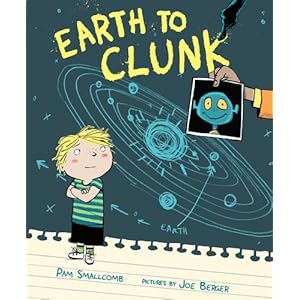
Pam is the author of several middle-grade novels including The Trimoni Twins series. She has recently begun writing picture books—I’m Not was published in January of this year and Earth to Clunk was published this month. Pam was an art major in college who later became a computer programmer (after growing weary of being a starving artist). Later, while raising her children and reading to them at night, her love of children’s books was reawakened. For more on Pam, see her web site.

Why did you decide to write children’s books? Was there an a-ha moment for you or did it come as a slower realization of something you could and wanted to do?

Actually, my initial interest in children’s books came from my art background. I thought I wanted to illustrate children’s books; hopefully my own children’s books. However, over time, the words took simply over, and the illustrating desire fell by the wayside. I love art, and it is big part of my life, as big a part as writing, but for me, the two have not yet blended. So not so much an “a-ha” moment, as it was that I found the words calling my name more than the pictures. For now.


What did you do to prepare? Did you take classes?

Although I took one children’s literature class in college, I think most of my preparation has been slanted toward what I could learn while I was at home with four small kids. I did take a picture book writing class with Deborah Nourse Lattimore through UCLA Extension. It was on Saturdays, and it was bliss. There was a Starbucks next door! Child-free for the morning AND I had coffee!. I have also attended writer workshops and retreats (through the SCBWI) when I could.

I spent a lot of my time reading. While my little ones grabbed their favorites at the library, I loaded up, too. I read books on writing. I read books written for kids, of all genres, but I was initially drawn to middle grade. Before I published my first book, I had read a ton of early readers and middle grade novels. I was also very lucky to have a group of friends that were interested in writing for kids. They were my first critique group.


How did you get the idea for the Trimoni Twins books? Do you think magic is a universal theme in children’s literature?

Yikes. Let me think. Some part of it had to be the triplets that attended my grade school in California. I was fascinated with them, and completely jealous that I didn’t have two identical sisters. For one thing, they never had to worry about who to play with at recess! As for the setting, I have always loved the artwork in old circus posters. I love those black and white photos of traveling circuses. Some part of me has romanticized that life. Later, in college, I actually knew a few magicians. One of them was very good at sleight of hand. I thought it would be fun if sisters that knew how to perform magic were also in possession of some actual magic as well.

I think magic appeals to kids because, for the most part, they are powerless in our world. Magic literally opens up portals. It throws them into adventures, and changes their surroundings. A little magic can make a kid the equal of an adult and then some. The concept of a real magical object appeals to us all. Who wouldn’t want to get their hands on one? I sure would. I think another aspect of magic that appeals to kids (and one that writers need to be careful to respect) is that magic always has rules. A magic spell can’t work one way one time, and then do something completely different the next time. Harry and Hermione know exactly which spells to use under the circumstances.


What have you done to market your books? Of the time you devote to being a writer, how much do you devote to marketing and publicity?

I have to confess that I am not very good about marketing my books. The truth is I would rather be writing than marketing. The majority of my time is spent on writing. I know this is not the popular (or even wise!) view, but there is only so much free time in life, and I would like to spend it creating, and not selling. Of course, the paradox is that if you don’t keep trying to sell your books, then editors might not be that excited to get another one from you, so I do try and get out there and do presentations. I have done SCBWI presentations, geared toward writers. I like talking to writers. I know some of what they are going through, and I like to share my own experiences and thoughts. I do give presentations to schools, although I really prefer to talk to one class at a time. I have more fun if I can ‘get to know’ the kids a little. I have also done book festivals, and presented to students at a local college. I think the trick is to not spend so much time doing all these events that you are no longer writing on a regular basis.


How did you find a publisher for your first book?

I heard that Bloomsbury US was looking for “humorous boy books.” At about the same time, my then-agent heard the same thing, and we decided to send in my manuscript for The Last Burp of Mac McGerp.


What’s a typical day of writing like for you? Do you keep to a schedule every day, or concentrate on writing only when you have a project already defined?

I try very hard to keep to a schedule, but as everyone knows, life sometimes has other plans. I know from experience that writing every day has many benefits. It is easier for me to look someone in the eye when they ask “What do you do?” and I answer “I’m a writer.” If I write every day, I make some progress, however small, toward my writing goal. If I write every day, I don’t lose the thread of my story. More importantly, I don’t lose the passion I have for my story.

I always have more than one project going, with one project taking center stage (being written) and the other one being in the planning/plotting phase. Or maybe I have a novel I am writing, and a picture book idea going at the same time. If something comes up, and I know I won’t be able to work on a project for a few days (or weeks!), I spend some time making notes about what I thought I was going to do next (in the plot, etc.).


Do you keep a writer’s notebook? If so, what do you jot in it?

I have a notebook that I call “The Brain.” I am hoping that this notebook will become an iPhone with all sorts of apps on it that I can use to stay organized. But for now, a spiral notebook is cheaper. The Brain is next to me most of the time, and I jot down all those things that keep you from concentrating. Things like “remember to set up dental appt.” I also write down ideas, or names for characters. Sometimes I write down a title, or a first sentence that pops into my head. It’s a real mish-mash of stuff. I also doodle in it while I am thinking about my story.


You’ve made the switch from writing middle-grade novels to picture books. Was that a difficult transition? What did you do to prepare for it (did use any brainstorming techniques)?

I think all writing is hard, so whether you are writing a picture book, or a novel, be prepared to sweat blood. Or maybe that’s just me. My preparation for writing a picture book was the same as I used to write middle grade. I read lots of picture books. I wrote lots of really bad picture books, and eventually I learned how to spot the bad ones earlier. I wish I could tell you that now I write really good ones all the time, but that hasn’t been the case, darn it.

I always use brainstorming techniques of one kind or another. I was just trying to think of a picture book idea the other day, and I found myself making lists of opposites. I looked up Romanian names. I looked up good luck charms. I think that I brainstorm in a fiddling fashion. I look up stuff, and make notes in The Brain. I sip my tea. I think about what I have written down. A new thought pops into my head and I look up something else. Hopefully, the seed of a story starts to form. It seems to be how I work, not just with picture books, but with novels, and with art, too. The idea is to tickle your imagination into connecting some of these things. Once you’ve connected them, then you can start moving the pieces around, and try and make them more surprising.


You’ve had two picture books come out recently—what are you working on next?

I’m working on a fictional memoir, and I am trying very hard to get one of my picture book manuscripts to behave. I am also plotting some chapter books that have been swirling around in my head for a while.


When/how did you realize that writing picture book text is a lot like writing ad copy (as you discussed at the SCWBI ABC event)?

My husband and I are one of those nerdy couples that loves a good commercial, or a print ad, or a clever viral YouTube. It was pretty easy to draw a parallel between the goals of a good advertisement, and the goals of a good picture book. You are trying to tell a story in a very short format. You want to grab the attention of the reader right away. You are trying to be original, and say something that has been said a million times before in a new and fresh way.

Sunday, March 20, 2011

The digital picture book takes hold

A week after I wrote my post, Five Arguments Against the Total Inevitability of E-books, the Washington Post Book World arrived with this article on the popularity of iPad picture books. So popular, in fact, the article states:

Earlier this week, eight of the top 10 paid book apps on iTunes were picture books. Today’s digital-native children seem keenly interested in a story told to them on a 10-inch screen with a finger’s swipe to reach the next page.

Thursday, March 3, 2011

The challenge (and joy) of writing picture books


I’d never thought about writing a children’s picture book until I heard Pam Smallcomb speak at a SCBWI-sponsored ABC (Author Book Club) event this week. (I’d assumed that children’s picture book authors do their own art and I knew that my own doodle-y art would never sell.) But Pam has sparked my interest in writing within this concise and often humor-filled form.

Not that she made it seem easy—writing a 250- to 600-words book is like writing a really good poem. You can’t just sit down and write something brilliant; you have to pare it down, then be willing to revise and/or rewrite it again and again until it says only what needs to be said and says it as perfectly as possible.

Pam compared picture book writing with advertising: you have to be aware of your target audience, know your message, and work on deadline. Like a TV commercial or ad campaign, she said, a good picture book crams a lot of story into a short amount of time and space. And you have to make it fresh, figure out a new way to say something that’s probably already been written about before.

As ad people do, Pam suggested using brainstorming techniques to come up with story ideas. (When brainstorming, don’t self-edit but let the ideas flow). Some of her suggestions included:

Blend two unlike things: Make a column of nouns, a column of verbs, then a column of nouns (or just two columns of nouns). Then crisscross them for incongruous combinations that can be used for titles and/or to spark story ideas.

Ask yourself the question: What was a bad/good day in my childhood?

Recycle. Revise and retool old ideas with new characters, settings or messages.

My friend, Mary, and I tried the first technique the next morning and came up with: "tomato-ottoman" (a garden that grows furniture instead of vegetables?) and "Beethoven-shoes" (the shoes of famous people through history? putting yourself into Beethoven’s shoes—too tragic?). I’m not sure these are books that will ever get written, but it was a fun way to get the (collaborative) creative juices flowing.

Wednesday, December 1, 2010

Yes I did!

Grab the time and do it—that's what I learned from NaNoWriMo 2010. Because of that contest, I wrote a 50,011 word novel in 30 days, a book that otherwise would never have been written.

I'm not sure that anyone can write a deeply nuanced and eloquent novel in a month—mine certainly isn't. But I didn't expect it to be. And that lack of expectation really gave me a wonderful freedom to write.

The other great thing about NaNoWriMo is that I could actually talk about it with people. I charted my progress on my profile page there (see chart from it, above), and put occasional updates on my Facebook page. It made my fiction writing visible, for once; I felt a part of a (temporary) community. And it made me write, no excuses. Dirty dishes, unmade bed, work deadlines—so what? I had 1,665 words to write each day and until they were done, I put other things aside. But, as you can see from the chart, I struggled to always find the time to write. Sometimes regular life was unavoidable.

In my novel, I wrote from the perspective of a 12-year-old girl, something I probably never would have otherwise attempted. It was the first thing that popped into my head on November 1st and I had to see it through, no time for redos or rewrites or more than minimal editing. I couldn't lose time to rethinking the plot or the characters. They were mine for 30 days.

Writing for the YA audience also required a more resolved and happier ending than the usual melancholy ending I fall into when writing for adults. I found the happy ending wasn't that difficult when it was inherent or organic to the story, so I hope I can write happier endings in the future even when I'm not writing for children.

Tuesday, November 23, 2010

An impromptu strategy session in the children's library

How cool is this—I visited a local public library this morning and mentioned my YA novel-in-process to the children's librarian. She got so interested in the project that she pulled another children's specialist from the back room and we sat around talking about it for a good 15-20 minutes.

I am at the point in my book where my heroine is going to seriously start "booking"—a verb I've made up for visiting scenes in books via a magic bookmark—through four books, and I hadn't finalized my list of books as of this morning. As I told the librarians, if I had a year to research this, I could take the time to read all the books (again) that I want her to visit.

She is booking through books that Ellen, another, older girl is supposedly lost in. My heroine, Sarah, and Mrs. Reid, the librarian who gave her the magic bookmark (and Ellen's mom), are trying to find a commonality among the four books. That's where I was stuck. I didn't want them just to be books that I knew about, but time is of the essence since I am writing the book for NaNoWriMo, and only have seven days left to finish it.

We finally determined that my original choices weren't so bad; the obvious commonality they share is water (though I also know that's not the reason that Ellen chose them).

I also asked if either of them knew of a book with the same kind of themes, characters, plot, etc., as mine. I have been worried about this since I have been so writing quickly and wondered if some of my ideas might be coming from something I'd already read. Fortunately, they hadn't.

How wonderful to have a fictional work taken so seriously—and what serious fun.

Sunday, November 21, 2010

NaNoWriMo Day 21

Today, on my 21st day into National Novel Writing Month, I am 28,499 words in—which might sound impressive until I hit the Stats bar on my NaNoWriMo Profile Page: I am 6,501 words behind. My suggested cumulative word count for the beginning of the day was 35,000 words.

It's not from lack of interest or idea on my part; life has gotten in the way. My kid's two full days and two half-days off from school this month, hubby out of town for consecutive weeks, and a half-day visit to the ER with E-girl for a broken arm, has meant that I haven't been able to sit alone and write at the computer for the two or three hours I need every day. Desperate, I have taken to writing paragraphs as multiple text messages on my cell phone or scribbling into a tiny notebook whenever I am sitting waiting anywhere or watching kids at play.

I have guiltily set E-girl in front of the TV on the schools days off, but I just can't put her there for more than an hour and a half. She needs fresh air and friends and interaction.

So I really want to write this book—all this time away from it has made me desperate to put it down, which is a wonderful thing, if you think about it. Without the pressure to finish it within a certain time frame, it might still just be another one of my good ideas I've never made time for. The less I am able to write it, the more urgent it has become for me.

Monday, October 11, 2010

Using WOW and other strategies to write and revise fiction


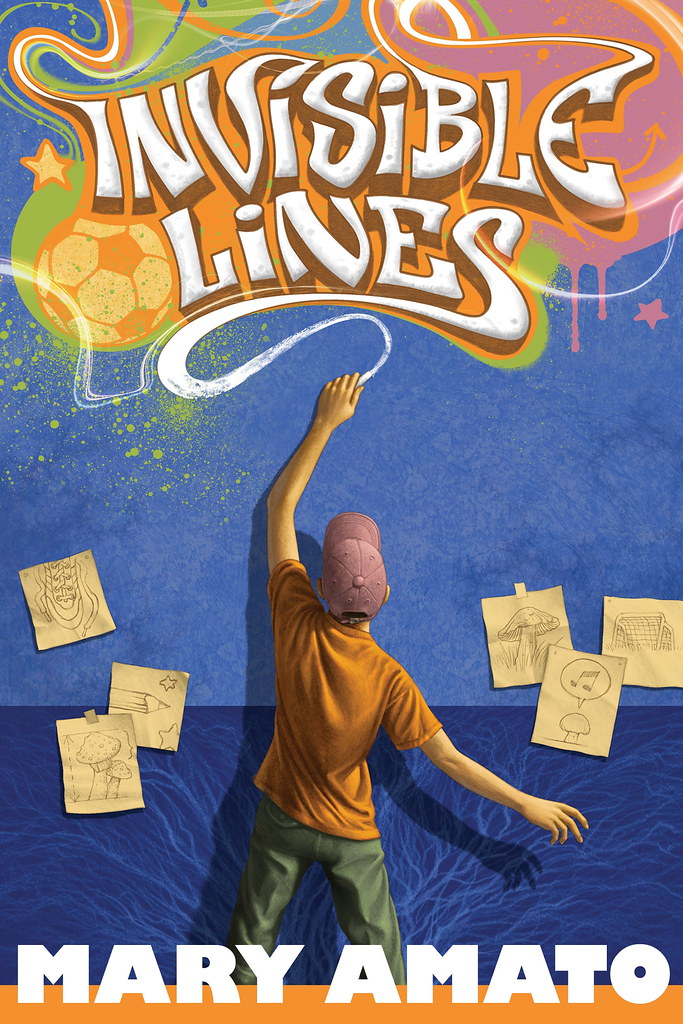
I went to a terrific workshop given by Mary Amato yesterday for SCBWI's Author Book Club. Her topic was Revision, specifically the 56(!) drafts she went through for her last book, Invisible Lines.

Mary spoke about all the levels of work she puts into a novel, from writing out all actions on wall charts, index cards, etc., to putting herself in the action she is describing. For instance, she had written a paragraph about a boy lying in the grass looking at the clouds, but it just didn't feel descriptive enough to her. So she got up from her desk, went to her backyard, and lay down on the grass. Just those few minutes gave her the idea of clouds imagined as graffiti, which became three pages of text.

Mary offered these 6 Things to Succeed with Revision:

  1. Fluidity: don't get stuck with ideas in your original draft (to divorce yourself from your own lovely prose, write out the actions as simple sentences to see if they work)
  2. Define yearning: every main character should want something (She suggests interviewing yourself as the main character, asking "Who am I? What is important to me? What do I want?")
  3. Define the story: use the WOW technique, e.g. Wants something; Obstacle; Win [for a description of this, see Mary's essay on How to Encourage Creative Writing]
  4. Get into character: literally act out the scene
  5. Use resonating motifs: make multiple story webs, if necessary
  6. Look at secondary characters and subplots: make sure they amplify the original theme
I didn't realize that writing a novel could be such hard work—which is probably why the only novel I've ever written is something I'm not even sure I want to re-read myself. But having this six-step outline makes me almost eager to revise it.

For more tips and recommended resources, see Mary Amato's Writer's Blog.

Saturday, September 4, 2010

The weird world of Nancy Drew

Assuming most young girls go through a Nancy Drew phase, I bought my tween the first two books in the series encased in a cute leather pocketbook set (seen above). She delved right in, working her way through the first few books without any problem.

But when she got to the sixth book, she said that she was having trouble keeping up with all the new characters and that, well, it was getting a little weird. So I volunteered to read it aloud to her, one chapter per bedtime; by the end, I agreed with her initial assessment.

If you haven't read Nancy Drew in a while, or if you never got to the sixth book, The Secret of Red Gate Farm, I'll summarize it for you:

Nancy and her cousins meet Jo, a young woman who passes out on their train; soon they decide to move to Jo's grandmother's farm as boarders—no explanation given as to how these young women can just uproot themselves like that. (Perhaps that is why these books have appealed to girls in the past; the girls are independent and of sufficient means, existing perpetually in the fleeting freedom between high school and motherhood.)

Friday, March 12, 2010

The problem with reading two books at once

As mentioned in a previous post (The writer, reading/listening), almost since our kids were old enough to understand one sentence following another, we've listened to books on tape during family car trips.

At first, we reserved them only for long journeys—I often remember past trips by the stories we heard along the way (our drive to Canada and back took as long as Fellowship of the Rings; now, when I think of traveling Montreal, I also sometimes think of Frodo traveling to Rivendell). But then we found it was nice to have a story to look forward to whenever we got into the car, even when we were just going to the grocery store.

We were able to keep the narrative going somehow, perhaps because it was such a defined space and we were a truly captive audience. The seatbelts click and the story starts again. Only occasionally did we need to back up a bit to catch up.

We've also always read to our kids aloud at night, from toddler to almost-teenage. This has never been a conflict before, listening to one story in the car, another at night. Until recently, when E-girl and I listened to City of Ember by Jeanne DuPrau and read When You Reach Me by Rebecca Stead. Both are mysteries written for children, presenting puzzles for the reader to figure out.

One night, about a week into both narratives, E-girl said, "I keep getting them confused." It was hard to remember sometimes which story had the man under the mailbox, which had the confused grandma. So we stopped listening to Ember until we finished the other book. Perhaps what made it even more difficult is that When You Reach Me keeps referencing A Wrinkle in Time, so we were having to keep three books separate in our minds, reminding ourselves that Linah and Doone couldn't time travel.

Today I went to the library and checked out two books on CD: Treasure Island and The People of Sparks (the sequel to Ember). I also checked out The People of Sparks on paper; we have a paper copy of Treasure Island already. I guess this is the way it will have to be for awhile, as long as we're listening to suspenseful or exciting books. The only problem for me, now, is that I will be competing with professional voice/actors when I read aloud at night.

Tuesday, November 24, 2009

My other kid

My teenage son, Isaac, came up to me a couple of days ago with a funny look on his face; after pausing for a few moments, he finally asked, "Why don't you ever write about me on your blog?"

While this isn't entirely true—he was mentioned in the posts Mea Culpa, Dinnertime conversations in an eccentric household, and Urban legends and bad poetry—they're all from last year.

The simple answer is that I didn't think he'd want me to mention him, especially in my recent posts about children's books. Yes, he sometimes listens to children's books in the car with me and his eight-year-old sister (usually as a captive audience), but I didn't think he'd want me to broadcast it. And, because he is gearing up to go to college next year, I guess I was granting him more independence, in my mind, than he would have as fodder for one of my blog posts.

The more complex answer is that I view his comics and short stories and doodles as his own creative/intellectual property, not something I can distribute without permission or that I should even ask permission to distribute.* They are his to do with as he wishes.

This begs the question, though—why do I feel that I can upload Emily's drawing and ideas but not his?

I suppose the main reason is that she doesn't have access to the Internet or other forms of distribution that he does, should he choose to share his stuff. I made that decision for her, then, when I shared samples of her Smiley Book Club and I'm not sure I entirely have that right. But I know, from past experience, that the titles from the Smiley Book Club are likely to disappear or rip or disintegrate in the next few years and be forgotten, and it was a way to preserve a sample of them electronically. And it was so perfect, to see the Smiley Book Club suddenly appear out of her backpack right after I wrote about listening to Andrew Clements' books. I hadn't known that his books (particularly Lunch Money) had had that much effect on her.

If blogs had been around when Isaac was young, I imagine I would have at least occasionally posted samples of some of his political cartoons and comics, particularly if they had been inspired by something he/we were reading. But the time has passed when I can post his childhood drawings—I don't want to embarrass him retroactively. And eventually, I suppose, Emily will want me to keep her drawings and books off my blog. I wouldn't want her to fear that showing them to me would risk their appearance on the world wide web.

So I have mentioned my son in my blog now. Perhaps this will be the last time he'll want me to mention him again, at least for awhile. But I'll certainly link to anything he chooses to put on the Internet in the future, proud mom that I am.

(* Addendum: Shortly after I initially posted this, Isaac suggested I add a picture of him as an illustration; he chose the digital self-portrait that now appears at the top of the post, which he drew this summer).

Saturday, November 21, 2009

The Smiley Book Club

A few days after I wrote my post on children's books, my eight-year-old daughter cleaned out her desk at school and brought home a collection of little books she has been writing whenever she finishes a test or task early. She calls them the "Smiley Book Club" and checks them out to her friends if they sign a take-out slip or promise to write a review on the back page, e.g., "This is a good book!"

Except for the fact that she is lending them out for free, her book club is reminiscent of Andrew Clements' Lunch Money, which we listened to in the car this summer. In the book, Greg Kenton creates the Chunky Comics book club and sells the comics to all his friends. His initial desire is to make money, not to be an author, but he discovers his creativity along the way.

She said her inspiration for "Chuckie Cheader" came from a combination of Chuckie Cheese and The Tale of Despereaux, which her dad was reading to her at night. I asked her why the mouse in the picture on the second page of her book repeats the text and she said, "Mom, that's a caption." I didn't know she knew what a caption was.

The inspiration for another book, "The Kings Wonderful Singing Dumplings," came from her love of Chinese dumplings and a fairy tale book that's in her classroom. "I tried to follow the fairy tale style," she says. In the book, the king finds his favorite dumplings sitting on the counter singing:

He picked one up and put it to his ear. Laaaaaaa!! He droped it with surprise. La La La La Laaa. The king was astoded. The dumplings were singing the most beautiful sound. He picked up the bowl and ran to the prime minister. "Listen to this!"...

How cool that is, to be inspired and then just go and draw or write something without worrying whether it is good or where it will be seen or what its purpose is. Children have a natural license to be creative. How do we lose it when we grow up? The only adults I know who have that capability are artists and writers—and maybe bloggers. I think that is why I choose to blog these days rather than writing pieces for publication. I'm inspired, I write, I put it on the computer and walk away. It is the process of getting something down, transforming a thought into words that matters. It is a form of elation.

(Note: The books were drawn with pencil on notebook paper and are hard to see unless you click on the picture and see them enlarged.)

Sunday, November 15, 2009

The writer, reading (listening)


“Read a lot” or “read widely,” writers are often advised. But most of my reading these days takes place in the car, with books on tape, and most of the books I listen to are children’s books. My daughter does not want to hear fiction written for adults—or any of the Teaching Company lectures (on Mark Twain, on great books, on the history of music, etc.) I was able to listen to when she was a baby and couldn’t complain about it.

She also likes to read one author at a time, everything they've written in order of publication, or all books in a series in exact numeric order. And so, over the course of a year, we listened to every Little House book. We listened to all the Beverly Cleary books that were available on tape, and I read the rest to her (first the Henry Huggins books then the Ramona series), a chapter at night before bed. She has been on an Andrew Clements kick lately and I sometimes find myself just as eager as she is to get in the car and see how the child protaganist(s) will figure out how to right things before the end of the book.

The thing about listening to books on tape instead of reading them is that, in my mind, the voice of the narrator often becomes the voice of the actor performing the book. When I think of the Little House books I now hear the raspy, slightly twangy voice of Cherry Jones (she of "24" fame). Ramona's story comes to me in the matter-of-fact delivery of Stockard Channing now. I'm not sure this would be a good thing for most people, but for me it has extended my repertoire of interior voices I hear when I read--I used to hear Dan Rather's voice when I read the newspaper, or the voice of a generic professor when I read anything philosophical. Now I am inspired to hear fictional characters in more than one voice when I read in silence, and I try to give them more individuality when I read aloud to her.

I've come to appreciate the complex simplicity of children's books (though my appreciation hasn't yet compelled me to attempt writing one). The plots may be simple, but the best writers really capture what it is like to be a child and/or present what it is that children want to hear. I am amazed that Beverly Cleary, already a responsible adult, was able to sit down and write about being seven years old. That Clements could take his experiences as a teacher and turn them around so that the children are at the center of his stories—the teachers are just there for occasional guidance and reaction. And, that the Little House books continue to present a world, as a teacher of mine in library school said, that children can relate to because it is one where children matter.

And so we ride along the streets, immersed in stories. Who knows what the other people sitting at the traffic light are listening to—talk radio? shock jocks? light rock? We are rehearsing for a holiday concert, struggling to survive in a prairie cabin, or walking to school in our new rain boots. And, sometimes, when we delve into fantastic tales like the Spiderwick Chronicles, we can almost see the fairies flying by.