Showing posts with label writers' tools. Show all posts
Friday, April 3, 2015
Using the watermark feature in MS Word to distinguish your drafts
Maybe most writers already know this, but I stumbled upon something accidentally tonight that is going to help me more easily distinguish which draft of a manuscript I am looking at.
While trying to insert page numbers in a document, I saw that one of the options under the "Insert" pull-down menu is "Watermark..." I realized I might be able to use a watermark to show which draft I am printing or looking at.
Watermark gives you a "Text" option, which is where you can put the date of the draft. It shows up underneath each page and looks like this (I am printing this without the text underneath so you can better see the watermark/date):
The date of the draft shows up as a faint gray color under the text--or if you want to spring for color printing, you could, I suppose, make it a different color.
One of my problems in going back and editing my stuff is that I will find four different versions of something and can't always tell which is the latest, especially after it has been printed. The filename can include the date of the last update of the draft, but that gets lost in the print-out. Another option, of course, is to add the draft date to the header or footer where the page number is.
The key thing is to use the date of the draft vs. calling something "Version 3" or "Draft 4"--especially if you are working on a longer work in pieces (i.e., and some of those things are actually version 3 and some are version 4), or if you are switching between computers.
For advice on how to find where the latest edits go to, and how to name your drafts, revisit Mary Amato's advice in a 2010 Writing Home post: 56 drafts and three little kisses.
Labels:
writers' tools
Tuesday, February 11, 2014
The Artist's Way
A few weeks ago, I began to dip into the book, The Artist's Way. In case you don't know it, it's a 12-week workbook for creative people to get their creative lives back on track. (I'd never heard of it until someone recommended it to me, despite its having sold over a million copies).
One of the things that its creator, Julia Cameron, recommends is doing "morning pages"—three pages a day of stream-of-consciousness babbling, preferably as soon as you wake up. That's all I had been doing so far. That explains my absence here because my morning pages (which I confess I often write in the early afternoon or even at dusk, or whatever is the soonest I have time to sit down and go at them) have replaced my attempts at blogging. I suppose that's because they serve a similar purpose for me—sharing my thoughts in the moment. Cameron recommends that people starting out with the program not look back at the morning pages for a while, so I can't dig through them looking for blog post fodder.
Today I began the first week of the program more or less in earnest. One of the things she suggests for this week is to work on affirmations and to listen for how your inner-censor will try to negate them. She calls these negative whispers "blurts." Listening for blurts is the real work here. She also offers a list of 20 common negatively held beliefs about being an artist. And there, at number 20, is mine: "20. It's too late. If I haven't become a fully functioning artist yet, I never will." The funny thing is that I said this to myself at the age of 30. It follows that if I haven't been published widely, it is too late; I am obviously not any good—never mind that I have been busy working jobs, rearing children, keeping house and pulling weeds in the garden, too busy to research markets, write cover letters and polish prose as much as I think it needs.
(I have always tried to assuage such negative talk with a reminder that Helen Hooven Santmyer published And Ladies of the Club at the age of 88; but looking at her entry in Wikipedia just now I see that she published a book when she was young, and continued to write and publish poetry while working as an English professor at Wellesley College. So that HHS story will no longer serve to soothe me.)
Does it matter when we create or how much we create as long as the desire to make something is not diminished? That is what I hope to teach myself this week. To stop whining and to just keep writing.
Labels:
creativity,
writers' notebooks,
writers' tools
Tuesday, January 15, 2013
Writing interesting characters
In Issue 55 of Writers Ask, Bret Anthony Johnston suggests making characters more likable by giving them at least one annoying habit ("We can't identify, not completely, with perfect characters, so as readers we resist and retreat from protagonists with flawless skin..."). OK, got it—I found this a fun and uninhibited task. My characters began tapping their feet nervously, clearing their throats, or clutching their steering wheels in heavy traffic until their knuckles turned white.
To make them more fully realized and interesting, Johnston also suggests answering a series of questions about each character you're creating. His list of questions included: "What does your character most want?" (some people have said that the answer to this question is the basis itself of a short story), and "What does your character most regret?" But the question I found easiest to answer was this: "What is in your character's wallet/purse?" Unfortunately, every character I have created since reading this has now carries an unusual purse or has an overstuffed wallet—a trait I rarely pay much attention to in real life. It became the first thing I wanted to describe about them when I got around to putting them down on paper.
I'm sure Johnston meant these few questions as a launching point, to inspire writers to pay more attention to detail, and to avoid writing about themselves. To simplify this exercise, you could make a list of intended/planned characters and assign each an outstanding characteristic. Or create some kind of rotating list of questions to answer about your fictional characters (which I will attempt in another post).
The problem for me with all these exercises is that most of my fictional characters don't begin as a visual presence but a voice. They start talking to me as invisible companions that accompany me during the day—like an ongoing internal seance. Perhaps I should try to see what they look like as they speak to me, or ask them what they really want, or what's in their wallets. Yet I'm afraid if I question them, at least while they're still trying to introduce themselves to me, they might vanish. It's probably better for me to write down the conversations (as much as I can remember them), then go back and embellish and add descriptions and stated desires after they've had a sufficient chance to confess their souls.
Labels:
characters,
fiction,
writers' tools,
writing advice
Thursday, November 29, 2012
Story maps
A while back, I started a Pinterest page on Writers Tools and Tips (that I've hardly added anything to lately...). To feed that page (and to have a permanent place to park this information), I'm uploading the Story Map I've started using when writing short stories. (You don't have to use it before you start the story, but it can help you at any time during the writing to clarify who is saying what, and how else a character might be described). I have created it and honed its elements based on fiction writing classes I've taken and books I've read over the years.
The image above is there for mostly for graphic purposes (and so I can link to it on that Pinterest page). Here it is as text, below, if you'd like to import it into word processing, and adapt for your own uses.
[Note: If you copy and paste this into Microsoft Word, and want to retain the table, choose the "Keep Source Formatting" option. You can still type into it. If you are bothered by the pinkish background that imports from this blog, though, you can paste the text and table separately—choose "Keep Source Formatting" for the table only, then under "Table Properties" choose "Shading"--no fill.]
STORY MAP
WORKING TITLE:
SETTING(S)
·
Year(s):
·
Season(s):
·
Place(s):
CHARACTERS
Name
|
Approx. Age
|
Physical description
|
PROBLEM:
CONFLICTS:
EVENT 1:
EVENT 2:
EVENT 3:
EVENT 4:
SOLUTION:
Labels:
fiction,
writers' tools
Sunday, November 25, 2012
Writing a novel, piece by piece
![]() |
| This is a Scrivener Corkboard being used to its full power—mine has few elements on it. |
Apparently I am a NaNoWriMo Rebel—one of the hundreds who don't follow the typical rules set forth by NaNoWriMo. I am a Rebel simply by not aspiring to write 50,000 words during the month of November. But I'm also a Rebel since I'm not really writing a novel but a set of inter-related stories, many of which are no more than a few vignettes and descriptions right now, which I am collecting in separate electronic folders.
It has been liberating to write like this. I am not trying to create a long, linear narrative and can choose to write a little bit in each story without having to connect any new writing directly to what has already been written—I can write about a past occurrence without bothering to present it as a flashback, or can write about a future event without worrying about having first to describe what has happened between times.
I have only been able to write this way because I am using Scrivener, a software package that promises to help writers "create order out of chaos" (though, right now, I'm embracing the chaos more than the order). Scrivener describes itself as "a powerful content-generation tool for writers that allows you to concentrate on composing and structuring long and difficult documents." So far I've only been using it in an elementary way, to move text around on its "Corkboard"and keep track of the word count for the entire manuscript, which is composed of seven half-finished stories. You can download it for free and give it a try (and then pay later if you decide it works for you).
I have yet to tap Scrivener's full power since I am too impatient to sit through all of its tutorials—but I intend to after NaNoWriMo 2012 is over (and I have reached my personal, 25,000-word count goal).
Labels:
fiction,
NaNoWriMo,
writers' tools
Thursday, March 29, 2012
Really there's no one-size-fits-all word count for fiction
I began my obsession with word counts a couple of weeks ago, at the beginning of writing a short story. I was 3,000 words into the first section and already wondering if the final draft would be too long to be published in a journal before I was finished with the thing. That, coupled with a new account on Pinterest, led me to create a Word Count Chart (which, FYI, I also pinned there on my Writers Tools and Tips board.)
Of course, there is no rigid definition of either a short story or a novel. I made the chart to get a general idea of what territory I was in—flash, novella, etc. But once you're ready to look for a publisher, it's best to know what your potential market wants: each literary magazine may have a different definition of the short story along with a suggested word count.
And those definitions may vary for special issues or occasions. For example, Glitter Train, which publishes only fiction, has a wide word count—"2,000 to 20,000 words"—for its Fiction Open. But they also have a Very Short Fiction Award for "up to 3,000 words."
I know of no short cut for finding a journal looking for a particular word count—but you can find journals according to genre through the Poets and Writers Literary Magazines database, and then link to individual journals to check their writers' guidelines.
Labels:
web sites,
word counts,
writers' tools
Sunday, March 18, 2012
More on word counts
My last post offered a list of suggested word counts for particular genres. But what if you'd like to know the exact word count of a published novel?
For children's books, check out the Renaissance Learning web site [thanks to Cheryl Rainfield for this tip!]. You can search by individual Title, by Recommended Reading Lists, or by Popular Groupings. Click on the link for the book title, which will take you to a page that lists info including number of pages, reading book level, and word count.
[Note: this next part has been amended] It is more difficult to find word counts for adult fiction...
- FYI (so you won't waste your time on this): Amazon Help says that its Search Inside the Book allows "text stats" searches, but it doesn't seem to work anymore.
- Indefeasible blog has a post that lists the word counts for famous works: Great Novels and Word Count (the author said he compiled them using English teachers' web sites)
- Just for fun, check out the Wikipedia page, List of longest novels
Labels:
word counts,
writers' tools
Word Count Chart
I couldn't find a chart anywhere in print or on the Web that showed suggested word counts for various genres, so I made one myself. (These are mostly general ideas/estimates and are not to be taken as gospel.)
Labels:
word counts,
writers' tools
Monday, October 11, 2010
Using WOW and other strategies to write and revise fiction
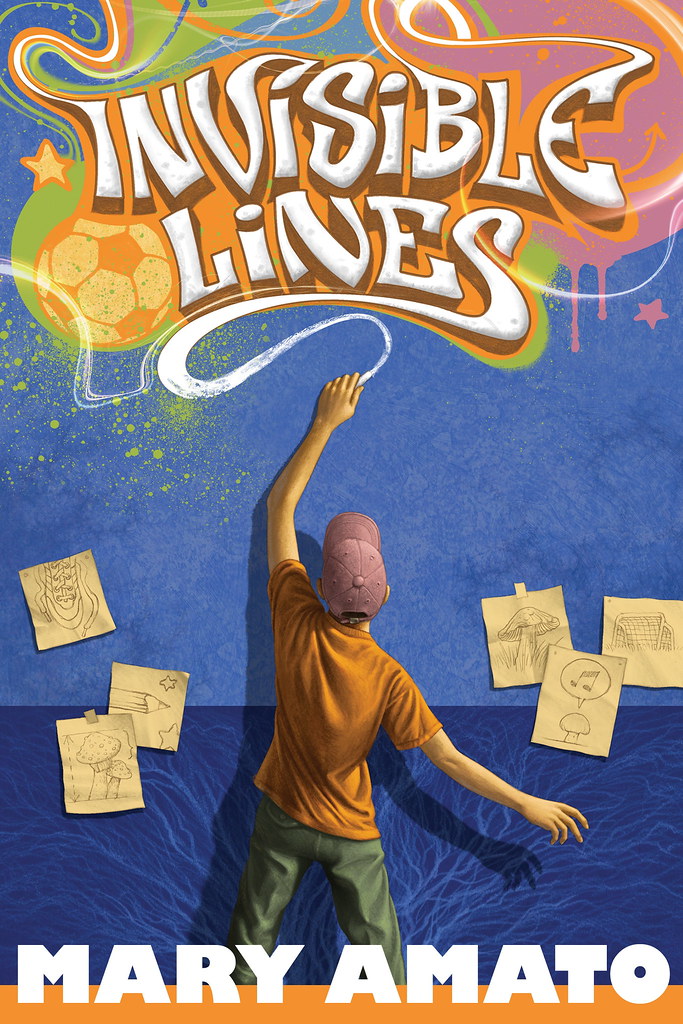
I went to a terrific workshop given by Mary Amato yesterday for SCBWI's Author Book Club. Her topic was Revision, specifically the 56(!) drafts she went through for her last book, Invisible Lines.
Mary spoke about all the levels of work she puts into a novel, from writing out all actions on wall charts, index cards, etc., to putting herself in the action she is describing. For instance, she had written a paragraph about a boy lying in the grass looking at the clouds, but it just didn't feel descriptive enough to her. So she got up from her desk, went to her backyard, and lay down on the grass. Just those few minutes gave her the idea of clouds imagined as graffiti, which became three pages of text.
Mary offered these 6 Things to Succeed with Revision:
- Fluidity: don't get stuck with ideas in your original draft (to divorce yourself from your own lovely prose, write out the actions as simple sentences to see if they work)
- Define yearning: every main character should want something (She suggests interviewing yourself as the main character, asking "Who am I? What is important to me? What do I want?")
- Define the story: use the WOW technique, e.g. Wants something; Obstacle; Win [for a description of this, see Mary's essay on How to Encourage Creative Writing]
- Get into character: literally act out the scene
- Use resonating motifs: make multiple story webs, if necessary
- Look at secondary characters and subplots: make sure they amplify the original theme
For more tips and recommended resources, see Mary Amato's Writer's Blog.
Labels:
children's books,
SCBWI,
writers--Amato-Mary,
writers' tools
Sunday, December 6, 2009
Markets for short non-fiction
I made this list of non-fiction markets for anyone who might benefit from it—but keep in mind it's mostly here so I won't misplace it! Markets that specifically publish flash or short non-fiction were hard to find, which is why I included the Creative Nonfiction list of publications from Poets and Writers; perhaps hyperlinking through it will lead to other markets.
Brevity - Check guidelines page for submissions calendar; usually don't accept in summer months.
Conclave - Publishes personal essays 750-1,000 words.
flashquake - Says it publishes flash fiction and non-fiction.
Poets and Writers - Creative Nonfiction list - A list of ALL literary journals in their catalog that print non-fiction, regardless of length. (But I thought the list was useful, so I'm including here anyway).
The Sun Magazine - Readers Write feature - No word limit given on guidelines page, but they normally run length of two columns or less. They list a new topic to write about each month, which Sun readers are to write about.
* * * * * *
Here are some anthologies devoted to short nonfiction (but, given the dates of publication, some of the markets/pubs are obviously no longer going to be valid):
Labels:
links,
markets,
non-fiction,
writers' tools
Wednesday, August 26, 2009
Facebook: Time-wasting guilty pleasure, or writer’s oasis?

Do you ever sneak onto Facebook, guilty that the tiny amount of time you linger there might have been better spent composing haikus or writing postcards?
I’m here to tell you that such guilt is unnecessary if you can view Facebook as a potential writer’s resource. Not only can you use FB without guilt, you can even feel justified in using it on a regular basis.
I’m not saying that you should go on and spend hours each day taking every FB quiz or playing every FB game that comes along. (Although, occasionally, you'll need to know such valuable information as your Gilligan's Island character.)
There are several uses I’ve found for Facebook. The first, and the most compelling for me is:
Facebook as an electronic diary
A few weeks ago, I was feeling glum that I hadn’t written a journal entry in months, not even in the pocket-size calendar I’d bought to record the occasional minutiae of daily life. (I always miss this stuff when I don’t write it down, months down the road. I find it comforting, in retrospect, to see what I was doing or thinking on a given day. Such info is also handy for writers who want to write about a real and particular day in the past.)
Then I realized I’ve been keeping an ongoing, electronic journal on FB through postings on the status line (aka the “What’s on your mind?” box). Of course, some of the time, I’ve attempted to be clever, but, more often, I’ve written down what I’m doing, much as I would in a regular journal, although, of course, more succinctly. Status lines, when taken as a cumulative whole, can reflect natural and cyclical patterns, from hot, humid days to snowed-in January afternoons.
And keeping a FB-based electronic journal doesn't require a lot of time. Most days, I go in, do my two minutes in FB to update my status and to see who/what else pops up on my Home page, and then I go off.
Here are some recent entries/comments. I’m posting them here mostly to show that none of these is especially profound. If I tried to be profound, I’d never post anything:
likes this cool, cloud-covered, humid morning.
August 14 at 9:08am
watched as a long black snake slowly slithered down the window ledge this morning.
July 30 at 4:44pm
lingering by the window, waiting for the sudden red buds on her hibiscus to bloom at any moment.
July 23 at 10:04am
is re-reading the Collected Stories of John Cheever, looking for a happy ending.
July 14 at 12:44pm
is going to D-Day beaches today
June 28
saw the sun for five minutes this morning. Oh well, at least I'm saving money on sunscreen.
May 6 at 11:24am
is watching the clouds roll by (the weather is changing here every five minutes)
April 3 at 2:04pm
spent the afternoon cleaning dead growth out of the herb garden in 70 degree weather—just 4 days after sledding in the backyard
March 7 at 7:35pm
Helpful hint:
If you decide to do this, you might want to download/keep your status lines every 2-3 months. In attempting to go back five months, I had to scroll down through screen after screen, and click on "Older Posts" at the bottom of the page. As the updates got older, FB became less cooperative, often not uploading the older posts the first one or two times I clicked on it.
NEXT POST: Facebook profile pages as fodder for fiction
OPTIONAL EXERCISES:
1. Gather up all your status lines from the last six months. Copy into a word processing program. Put in page breaks between months. Add other things to each page, whether from a paper calendar, an email or a paper journal, trying to arrange by date. Print and put in a notebook marked "Journal."
2. Gather up your status lines from 2-3 computer screens. Copy them into a word processing program. Add only a sentence between each and try to compose the opening page of a short story, or a poem.
NEXT POST: Facebook profile pages as fodder for fiction
Labels:
Facebook,
Internet,
journal-keeping,
memories,
writers' tools
Tuesday, December 16, 2008
Is Google book search a good or bad thing for writers?
Last week I created a "Special Features" section on this blog and helpfully included a "Writers' Tools" link, only to realize I'd written exactly one post indexed that way. So, I'm gathering up info I've meant to share—and to put somewhere that's multi-accessible for my own purposes—and will attempt to post regularly on writers' tools until the section gets plumped up.
• I love that I can search in almost any book ever published for whatever search terms I throw into it. Through a search for "women and creativity," "women and writing," and variations of those terms, I found the books, Word: On Being a [Woman] Writer and Sleeping with One Eye Open, which I never would have found in my local library (or known to find through an Amazon book search). In fact, Sleeping with One Eye Open inspired a post for this blog and a fan letter to one of its editors, Judith Ortiz Cofer, who wrote me back.
GBS offers full and limited previews of some books, snippets of others. With even just "limited preview," I've been able to read through sections of books and decide whether I want to further pursue an author, which for me these days means, mostly, obtaining the book via interlibrary loan from my local library. I am tapping into the richness of a universal library for free.
I also can't think of any other tool currently available to writers that allows them the potential to search for phrases and terms that have already been published in books. Maybe you think you've come up with a fantastic sentence in a short story, but worry that it's something from memory and not newly inspired. First, you'd want to search it on Google, which will pick up phrases on blogs and web pages, then search for it on GBS.
Here's an example: I mentioned googling the phrase "inner Julia Child" in my post about writing in a vacuum-less world. I tried the phrase in GBS and the results showed it was also mentioned in the book, The Fun Book for Couples ("Discover your inner Julia Child with a series of in-home cooking lessons a deux") and the July 2005 issue of Cincinnati Magazine.*
Writers can also use GBS for background research, edification and vanity searches. For example, I have learned more about feminist writers from searching for creative women quotes than I could have in any other way except maybe taking a college course; and, I plugged my name into GBS just now and found that it remembers the little magazine I published, the grant guide I edited, the poem I published in Kalliope.
• But I hate the idea that people will be using GBS instead of going to a bookstore and browsing (and buying) books. I worry that Amazon and GBS are killing the neighborhood bookstore and even the chain bookstores, and that public libraries will be diminished when people can search for what they want from their home computers.
I'm annoyed at the idea that given the possibility of searching through almost everything that has ever been written, I will be less likely to attempt to write something new, and maybe some writers will even give up writing when confronted with everything at once that has already been said.
And I am especially incensed to imagine a time when writers stop getting paid for almost anything they write and that we all, in essence, become bloggers. If no one is buying books (except libraries) and everyone else is reading books/text via GBS, the publishing industry may grind to a halt. Of course, on the bright side, Google supposedly is paying publishers for what they put in their database, so this may be the new model of publishing in the near future.
--------------
* NEWS FLASH: GOOGLE BOOK SEARCH HAS JUST ADDED A LIMITED NUMBER OF MAGAZINES TO THEIR SEARCH RESULTS...ONLY A FEW MAGAZINES SEEM AVAILABLE RIGHT NOW, WITH LIMITED PUB DATES.
For the full agreement and information on what Google Books accesses and will access in the future, see the page on Google Book Search Settlement Agreement.
Labels:
Internet,
publishing,
women,
writers' tools
Sunday, July 27, 2008
Useful Writers' Web Sites
I took a workshop on Flash Fiction yesterday with C.M. Mayo at the Writers Center in Bethesda. Two of the web sites she recommended were:
• Council of Literary Magazines and Presses. Offers a directory of its members, which include quality lit journals, both in print and as a list of links:
http://www.clmp.org/directory/index.php. You can check the list for possible markets and verify legitimate/literary pubs.
Another page on the CLMP web site simply says "Links"--there you'll find four categories of links:
Get Indie Lit (123)
Publishers (192)
Resources for Publishers (225)
Resources for Writers (57)
Get Indie Lit (123)
Publishers (192)
Resources for Publishers (225)
Resources for Writers (57)
• Mayo also recommended her own web site, of course: C.M. Mayo.
A useful resource on her web site is the "Workshop" page, which links to her Giant Golden Buddha page--365 days of 5-minute writing exercises. We did a few of these in class and they were fun and stimulated lots of ideas.
Workshop also includes Resources for Writers, which discusses the writing biz, writing workshops and editing.
Labels:
web sites,
writers,
writers' tools
Subscribe to:
Posts (Atom)